
Thermal Precision Profiling Tool
Overview
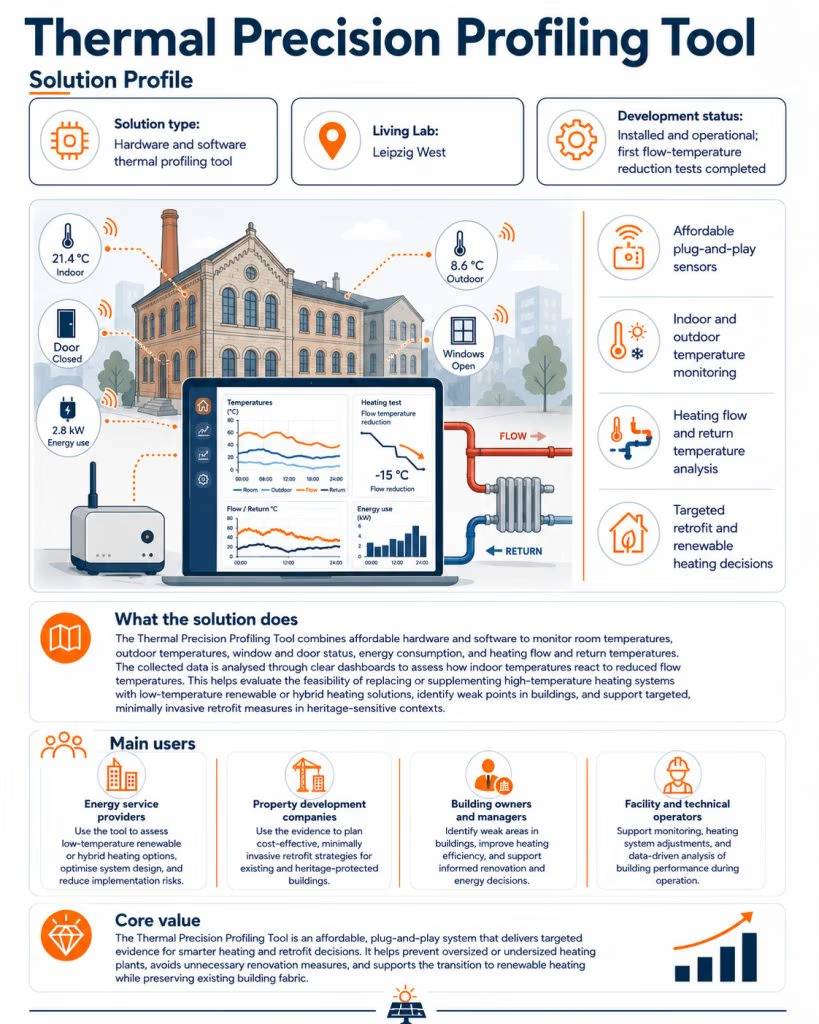
Thermal Precision Profiling is a digital tool that uses detailed sensor data to create precise thermal profiles of buildings. By monitoring energy consumption, indoor conditions, and heating system performance at a granular level, the tool generates data-driven recommendations for lowering flow temperatures in heating systems while maintaining comfortable indoor conditions.
The tool is particularly valuable for heritage-protected buildings where invasive retrofitting options are limited. Rather than modifying the building fabric, the approach optimises the heating system’s operational parameters reducing energy waste without compromising the building’s historic character.
The tool also supports the identification of buildings suitable for connection to future low-temperature district heating networks, creating a pathway for broader decarbonisation.
- The Challenge It Addresses
- Technical: Heritage buildings often have inefficient heating systems that can’t be easily upgraded due to structural constraints. Optimising operational parameters offers an alternative to structural retrofitting.
- Financial: Lowering flow temperatures reduces energy consumption and costs without requiring expensive building fabric modifications.
- Stakeholder: Tenants and building owners need evidence-based assurance that comfort will be maintained before agreeing to changes. The tool provides real-time, transparent data.
How It Works: The system builds on the existing LoRaWAN sensor network and Cenero.one energy management platform installed at the Baumwollspinnerei during the SPARCS project. Key components include:
- Sensor network: Digital meters and sensors monitoring energy consumption, temperature, and heating system performance across selected heating circuits
- Flow temperature stress testing: Facility managers systematically lower the flow temperature in the selected heating circuit while sensors monitor indoor conditions in real time
- Data analysis: The cenero.one platform validates and plausibility-checks data, enables the creation of dashboards and visualisations, and provides the basis for data-driven recommendations.
- Reporting: Results are presented to decision-makers and investors for potential implementation
Key outputs:
- Detailed thermal profile per building/circuit
- Recommended minimum flow temperature maintaining comfort
- Energy savings estimate
- Suitability assessment for low-temperature district heating connection
Where It’s Developed: Living Lab Leipzig West, tested at the Baumwollspinnerei, with a reference deployment at the Auf AEG site in Nuremberg (a 160,000 m² former industrial heritage site with an extensive LoRaWAN network and sensor-equipped reference room).