
Neighbourhood Heating Storage System
Overview
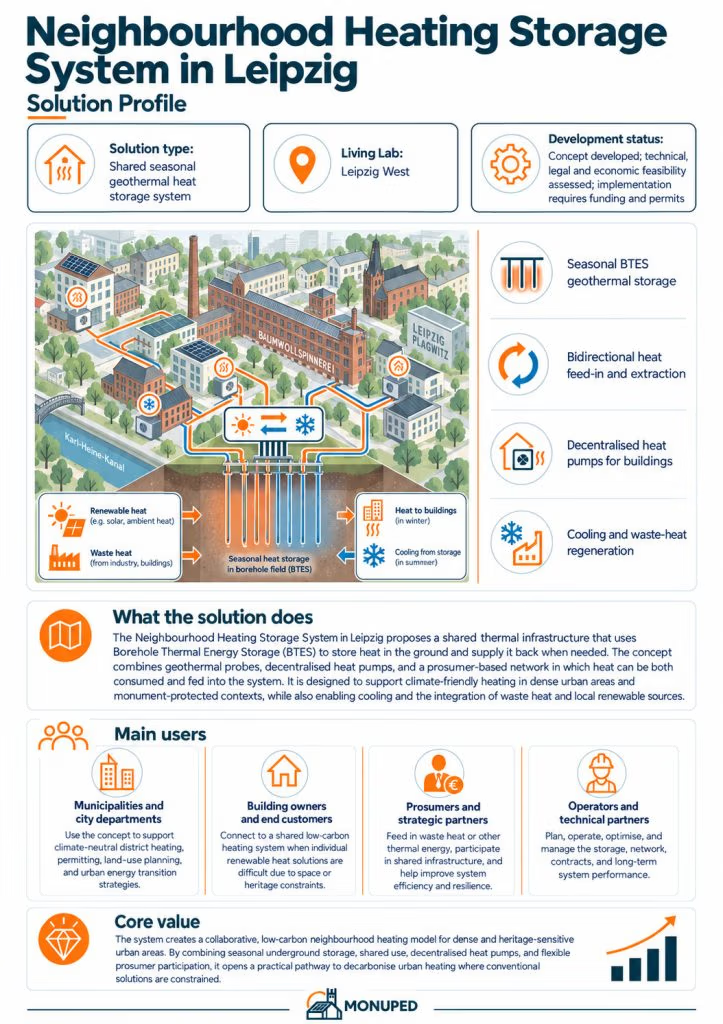
The Heating Storage System is a communal heat storage concept that connects decentralised geothermal probes across urban districts. By allowing multiple buildings to share the use of these probes, the system reduces drilling costs, increases resource efficiency, and supports the decarbonisation of heat supply. Particularly relevant for heritage-protected building ensembles where individual interventions are constrained.
Within MonuPED, a feasibility study is being conducted with a primary focus on evaluating the relevant legal and regulatory frameworks. The study also explores the potential for implementing geothermal drilling in public spaces, such as streets, to further expand and enhance the concept.
This concept known as Enercircle enables sustainable, centrally managed heating and cooling solutions by connecting buildings that might otherwise be unable to install individual geothermal systems due to space limitations, heritage restrictions, or cost barriers.
- The Challenge It Addresses
- Technical: Heritage-protected building ensembles like the Baumwollspinnerei often lack space for individual geothermal installations. Shared infrastructure bypasses this constraint.
- Financial: Drilling costs are prohibitively expensive for individual building owners. Shared use dramatically reduces per-building costs.
- Regulatory: The feasibility study specifically evaluates legal frameworks for geothermal drilling in public spaces — a regulatory grey area in many jurisdictions.
How It Works
The system connects decentralised geothermal probes, in boreholes drilled into the earth to access stable ground temperatures, into a shared network. A centralised management system distributes heating and cooling across connected buildings based on demand. The key innovation is the communal ownership and management model; rather than each building drilling its own wells with probes. Multiple buildings share access to a pool of probes, potentially located under public infrastructure such as streets.
Key features:
- Decentralised probe network with centralised management
- Reduced drilling costs through shared infrastructure
- Increased resource efficiency and availability
- Support for decarbonised heat supply by 2045
- Potential for geothermal drilling in public spaces (under feasibility study)
Where It’s Developed:
Living Lab Leipzig West; the Baumwollspinnerei site provides an ideal testing context: a 100,000 m² heritage-protected industrial ensemble with 20 buildings, an existing heating network, and active stakeholder engagement from the property owner and energy management company.