
HeritSAGE Digital Twin
Overview
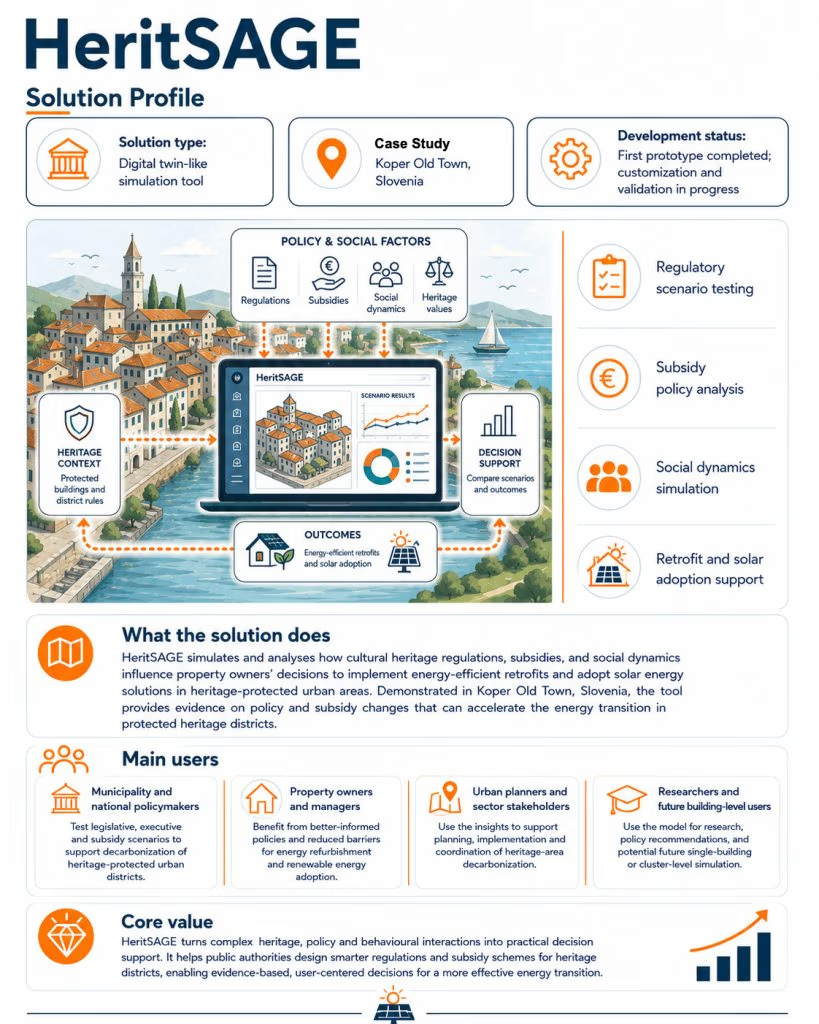
The HeritSage Digital Twin for Urban Heritage Areas is an agent-based model that simulates citizen engagement in creating a net-positive energy district within a cultural heritage-protected area. Rather than modelling physical energy flows, this tool models human behaviour. How property owners decide whether to invest in energy retrofits and renewable energy under different regulatory, financial, and social conditions.
The tool demonstrates its capabilities through the use case of Koper Old Town, a medieval coastal settlement where thick stone walls and strict heritage protection severely limit conventional energy interventions. By simulating how different policy measures, regulatory changes, subsidies, non-financial support, influence property owner decision-making, the tool helps policymakers identify which interventions would most effectively spur energy transition.
The tool models users and their behaviour through their interaction with cultural heritage regulations concerning energy consumption and creation, providing insight into how to accelerate decarbonisation in the most constrained heritage contexts.
The Challenge It Addresses
- Regulatory: Heritage protection creates complex constraint landscapes. The tool lets policymakers simulate the effect of regulatory changes before implementing them.
- Financial: Subsidy design is often guesswork. The tool simulates which subsidy structures motivate property owners to act.
- Stakeholder: Property owner behaviour is the bottleneck in heritage-area energy transitions. The tool puts human decision-making at the centre of the analysis.
- Technical: In contexts like Koper where geothermal and wind are ruled out and PV is heavily constrained, the tool helps identify which remaining pathways; roof retrofitting, off-site energy communities; are most likely to gain traction.
How It Works
The tool uses agent-based modelling (ABM) — a computational approach where individual “agents” (representing property owners) are simulated as autonomous decision-makers interacting with each other and with their environment:
- Agents: Each agent represents a property owner with specific characteristics (building type, income, risk tolerance, heritage constraint level)
- Environment: The model encodes heritage protection regulations, subsidy schemes, energy prices, and available technologies
- Behaviour rules: Agents decide whether to invest in retrofits or RES based on their characteristics and the policy environment
- Simulation: Running the model under different policy scenarios reveals which interventions lead to the highest adoption rates
Key features:
- Agent-based simulation of property owner decision-making
- Scenario testing for regulatory and subsidy changes
- Econometric and social behaviour knowledge base
- Scalable from district level to single building or building cluster
- Demonstration use case: Koper Old Town
Where It’s Developed:
Case Study Koper, Slovenia — developed by ZVKDS with research collaborator InnoRenew CoE that works with partner SUSTAIN as subcontractor.