
Heritage Optimiser
Overview
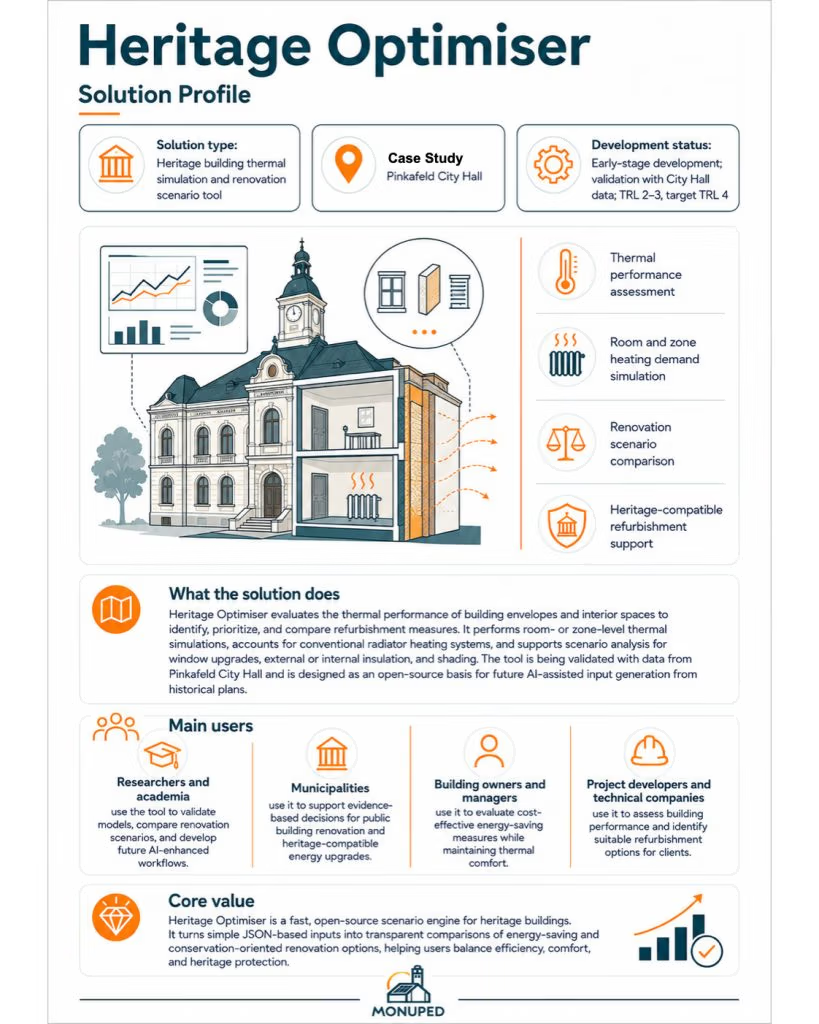
The Digital Tool developed for Pinkafeld City Hall is a building performance analysis tool that collects, analyses, and simulates detailed energy consumption data for a specific use case building. The tool aims to provide targeted recommendations for building owners regarding retrofitting and efficient energy use. Particularly in the context of a heritage-protected municipal building with aging infrastructure and limited intervention options.
The tool shares methodological foundations with the Thermal Precision Profiling tool being developed in Leipzig. Both focus on improving building performance through detailed energy data analysis, and both target heritage-protected buildings where structural modifications are constrained.
By comparing methodologies, data interpretation strategies, and user engagement approaches between the two sites, both tools benefit from mutual learning and shared
experiences. In the medium term, simulation results from one tool may complement or validate findings from the other, especially where building types or usage patterns are similar.
- Technical: Aging electrical and heating infrastructure complicates the integration of smart energy systems. The tool provides a data-driven baseline for targeted upgrades.
- Spatial: The compact site and preservation requirements restrict large-scale renewable energy installations. The tool identifies the most impactful interventions within these constraints.
- Stakeholder: The PED concept is relatively new to local actors in Pinkafeld. The tool provides concrete, visual evidence to build awareness and support.
- Energy efficiency: Heritage features limit structural modifications. The tool focuses on operational optimisation and targeted, non-invasive interventions.
How It Works: The tool follows a data-driven building performance approach:
- Data collection: Energy consumption data gathered from the City Hall’s existing and newly installed sensors
- Analysis: Detailed analysis of consumption patterns, identifying inefficiencies and improvement opportunities
- Simulation: Modelling of potential retrofit scenarios to predict energy savings and operational improvements
- Recommendations: Targeted, building-specific advice for the property owner (the Municipality of Pinkafeld)
Key features:
- Building-level energy consumption monitoring
- Retrofit scenario simulation
- Heritage-constrained recommendation engine
- Comparative analysis with Leipzig Thermal Precision Profiling (cross-site)
Where It’s Developed: Case Study Pinkafeld, Austria and is developed by Forschung Burgenland GmbH in collaboration with the Municipality of Pinkafeld.