
Energy & Solar Mapping Tool
Overview
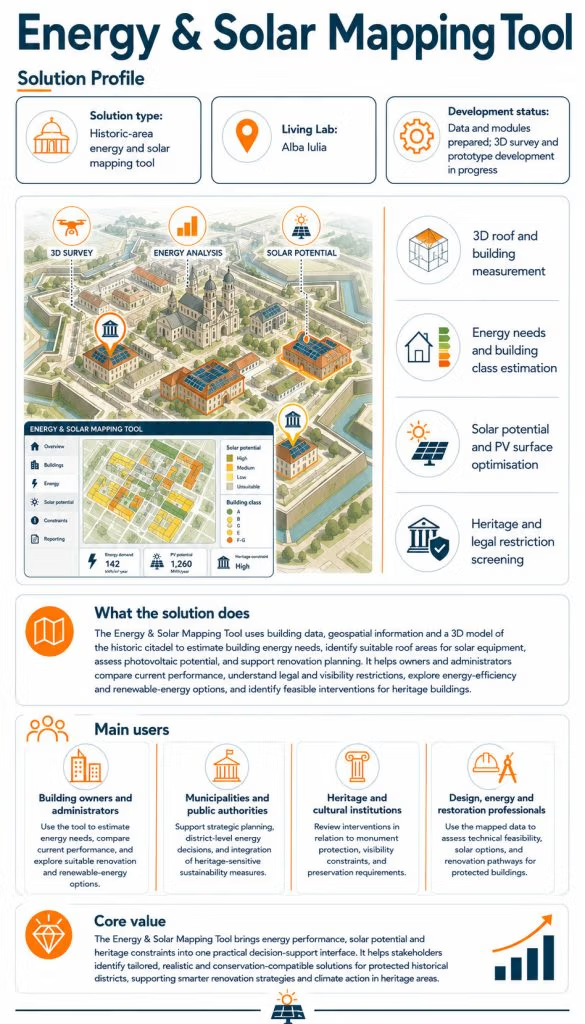
The Energy & Solar Mapping Tool provides a data-driven baseline for energy retrofitting recommendations in Alba Iulia’s Vauban fortress. A 70-hectare heritage-protected area with approximately 50 monumental buildings under diverse ownership.
The tool maps energy consumption data and solar generation potential across the fortress area, addressing a critical gap: because the buildings are owned by different entities (churches, the university, the county council, private owners), there is no centralised data about energy needs or consumption, only estimates. The tool creates a shared evidence base for decision-making.
Given the strict heritage and archaeological constraints in Alba Iulia, where geothermal, wind, and visible PV are largely ruled out. The tool focuses on identifying the limited but meaningful intervention opportunities that remain, such as non-visible roof surfaces for PV and building-level energy efficiency improvements.
The Challenge It Addresses
- Technical: No centralised energy data exists for the fortress’s ~50 buildings due to diverse ownership. The tool creates this baseline.
- Regulatory: Maps the constraint landscape, which areas allow which interventions so property owners can see what’s possible.
- Financial: Quantifies energy savings potential per building, supporting investment case development.
- Stakeholder: Provides a common data foundation for engagement with the fortress’s diverse building owners.
How It Works: The tool integrates:
- Building energy consumption estimates (due to lack of metered data)
- Solar potential assessment for non-visible roof surfaces
- Monument protection and archaeological constraint overlays
- Building characteristics (age, type, use, ownership)
Key features:
- Fortress-wide energy consumption mapping
- Solar potential for heritage-compliant roof surfaces
- Constraint overlay (protection zones, archaeological areas, visibility limitations)
- Per-building retrofitting recommendation baseline
- Designed for diverse ownership contexts
Where It’s Developed: Living Lab Alba Iulia — developed by Alba Iulia Municipality (AIM) with technical support from 1 Decembrie 1918 University and the Technical University of Cluj-Napoca.